
Email Delivery Specialists Since 2011
Email Delivery That Helps Revenue Campaigns Reach the Primary Inbox
Email delivery is the single biggest lever most direct-response senders never fully control. Digital Bulldogs rebuilds damaged domain reputation, protects healthy sending domains, and helps revenue-generating campaigns reach the inbox instead of getting buried in spam or promotions.
Built for direct-response marketers, affiliates, agencies, and high-volume senders who need reliable inbox placement, not generic email advice.
Quick answer: what are email delivery services?
Email delivery services are the done-for-you work of getting a sender’s mail accepted into the primary inbox instead of spam: fixing authentication, repairing sender reputation, warming domains, cleaning the list, and monitoring placement by provider. Digital Bulldogs has run that work since 2011 for direct-response marketers, affiliates, and agencies. It is a managed programme on your own domains — not a tool you log into.
Mailbox providers score your sending domain before they score your creative. Our email delivery programme moves the signals they actually measure — authentication, complaint rate, engagement, and volume consistency — and holds them there while your volume grows.
Why Email Delivery Breaks Down
Almost every email delivery failure traces to one of four causes, and none of them is your template.
Authentication that only half passes
SPF present but DKIM missing, DMARC published but unaligned, a sending subdomain nobody added to the record. Google’s email sender guidelines require bulk senders to run SPF, DKIM, and DMARC together with From: alignment, and Microsoft now rejects unauthenticated bulk mail to Outlook.com outright.
A complaint rate above the line
Google asks bulk senders to hold spam complaints below 0.30% and advises staying under 0.10%. That is one complaint per thousand as a working target. Cross it and email delivery degrades across every campaign on the domain, not just the one that caused it.
A domain with no usable history
New domains have no record to judge. Dormant ones have a record that has gone stale. Both get treated cautiously, and sending real volume on day one is the fastest way to convert caution into filtering — see our 8-week email warm up schedule for what a safe ramp actually looks like.
A list that stopped being clean
Unengaged subscribers do not just fail to open — they drag engagement metrics down and raise complaint risk on every send. If open rates fell without a campaign change, start with why open rates suddenly drop; if mail has stopped arriving entirely, a blocklist entry is the first thing to rule out.

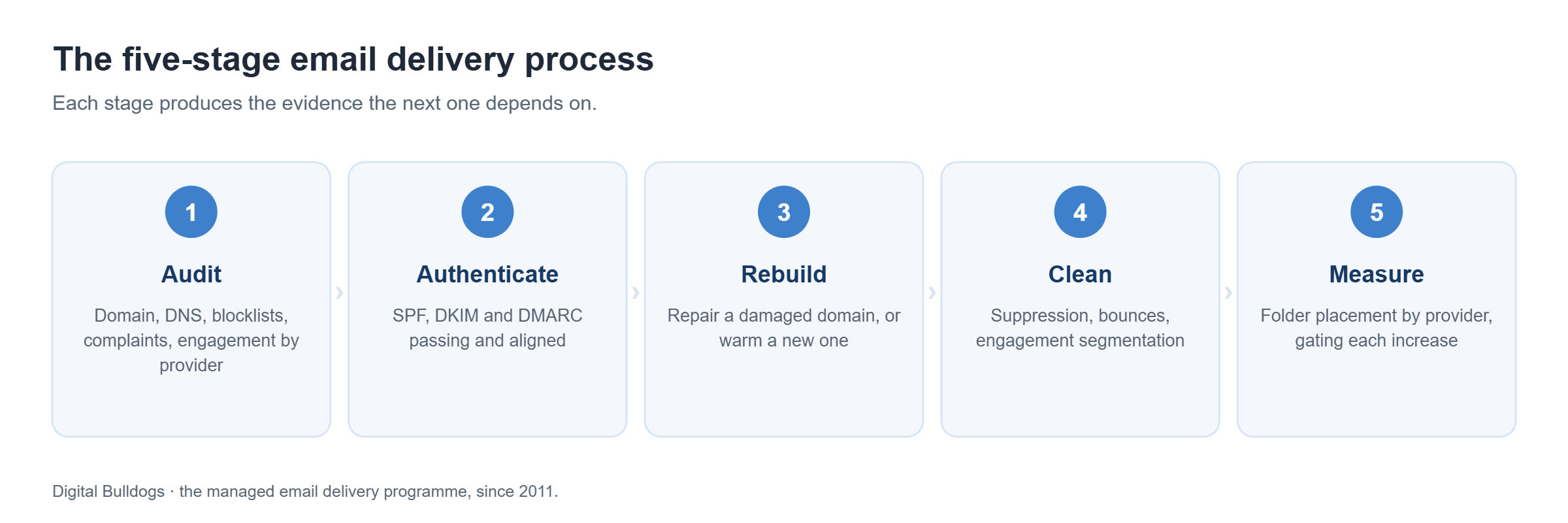
How Our Process Works
1. Audit the sending identity
We start with the domain, DNS, blocklist status, complaint and bounce profile, and engagement split by mailbox provider. The deliverable is a ranked list of what is actually suppressing email delivery, ordered by impact rather than by how easy it is to fix. The free email deliverability audit is where that starts: it reads SPF, DKIM, DMARC, MX and BIMI for your sending domain, and a specialist reviews the result before we talk.
2. Repair authentication
Records get published, aligned, and verified passing before any reputation work begins. Email delivery cannot be rebuilt on records that fail. That is handled through DNS authentication setup, and SPF, DKIM and DMARC explained covers what each record does if you want the detail first.
3. Rebuild or build reputation
A damaged domain goes through domain reputation repair. A new or dormant one goes through warm-up and seeding instead. Both route through an engagement network of real opted-in subscribers rather than automated inboxes.
4. Clean the inputs
Suppression, bounce handling, and engagement segmentation run continuously through list management and hygiene. Email delivery is only as good as the file behind it, and a file nobody has pruned in a year will undo good authentication work within weeks.
5. Measure placement, not delivery
A message can be accepted and still land in spam, so email delivery is measured at the folder rather than at the gateway. We track placement by provider through inbox placement monitoring. Every volume increase is gated on those numbers rather than on the calendar.
What the Service Includes
- Sending audit — domain, DNS, blocklists, complaint and bounce profile, engagement by mailbox provider, with a ranked remediation order.
- Authentication build or repair — SPF, DKIM, and DMARC published, aligned, and verified passing before volume moves.
- Reputation work — repair for damaged domains, paced warm-up for new and dormant ones, run on a fixed schedule calibrated to domain age and list size.
- Engagement seeding — real opted-in subscribers across Gmail, Outlook, and Yahoo generating genuine opens and reads.
- List hygiene — suppression, bounce handling, and engagement segmentation to keep complaint rates under the ceiling.
- Placement monitoring — inbox versus spam versus promotions by provider, with reputation checkpoints before each volume increase.
- Reporting you can act on — what moved, what did not, and what the next gate is. No dashboards you have to interpret alone.
Every email delivery programme runs month to month with no long-term contract. The wider menu, including audience work, sits on the services overview.
What Every Sender Has to Clear First
Email delivery starts with compliance, not with reputation. Before reputation work is worth starting, three sets of published rules have to be satisfied. They are not optional, and a programme that skips them is spending your money on a domain that was never going to be accepted.
Gmail and Yahoo both require SPF, DKIM, and a published DMARC policy from bulk senders, plus a working one-click unsubscribe honoured within two days. Microsoft went further in May 2025: mail from high-volume senders that fails authentication to Outlook.com, Hotmail.com, or Live.com is rejected outright with a 550 5.7.515 error rather than filtered to junk.
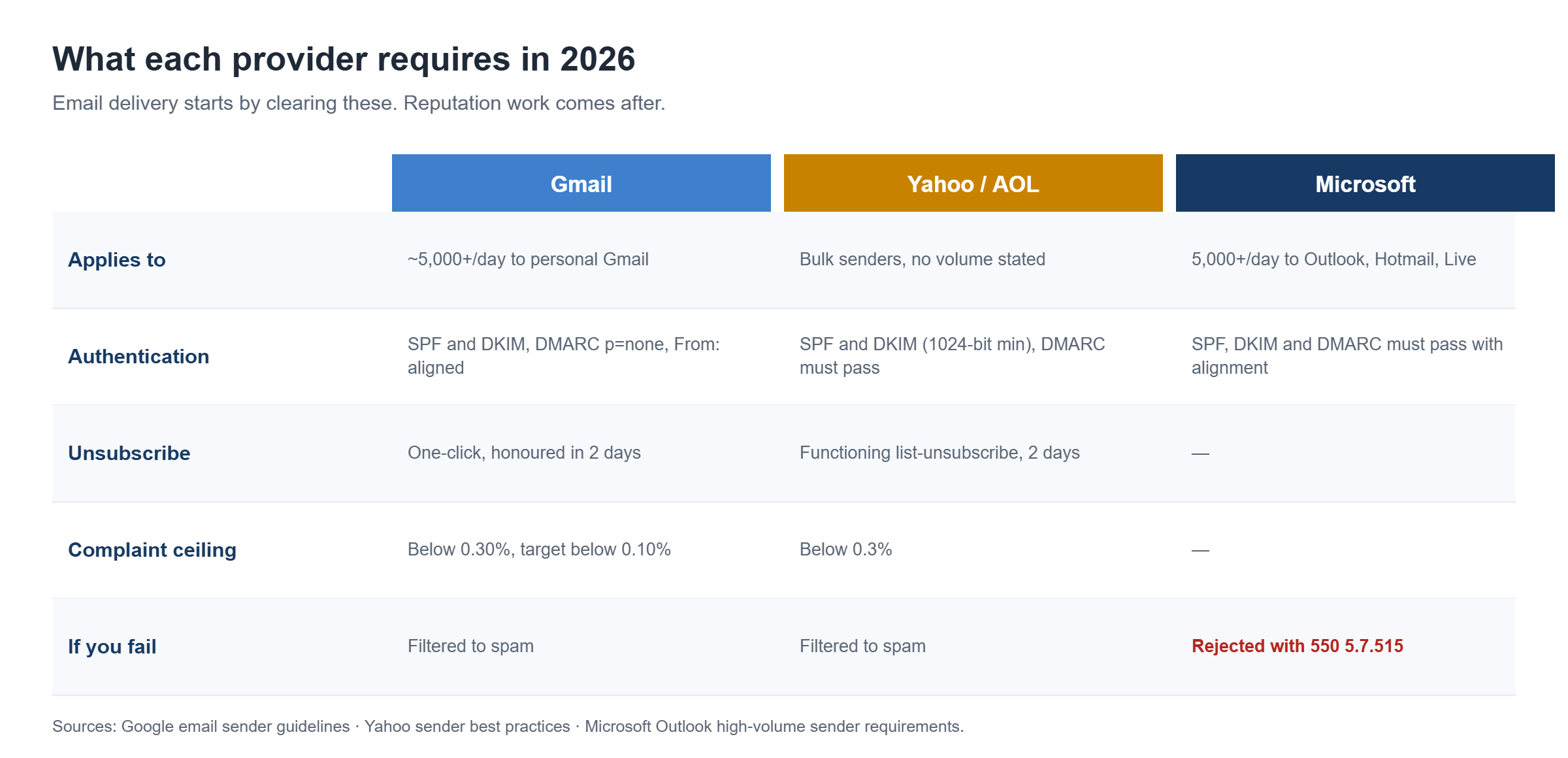
Alignment is the requirement senders miss most often. Publishing a DMARC record is not the same as passing DMARC — the domain in your From: header has to align with the domain that passed SPF or DKIM, which RFC 7489 defines precisely. Third-party sending platforms break that alignment routinely unless the records are configured for them.
What Changes in the First 30 Days
Email delivery work in week one is diagnostic and corrective. The audit runs, authentication gets fixed, and any blocklist entries go into a delisting process. Sending volume does not change yet, because raising volume on a domain that is still failing checks simply produces more failed messages.
Weeks two and three are where the signal work starts. Seeding begins, the most engaged part of your file leads the sends, and volume climbs on a paced schedule rather than a target date. This is usually when the first email delivery movement shows in Postmaster Tools — not a jump to High reputation, but an end to the decline.
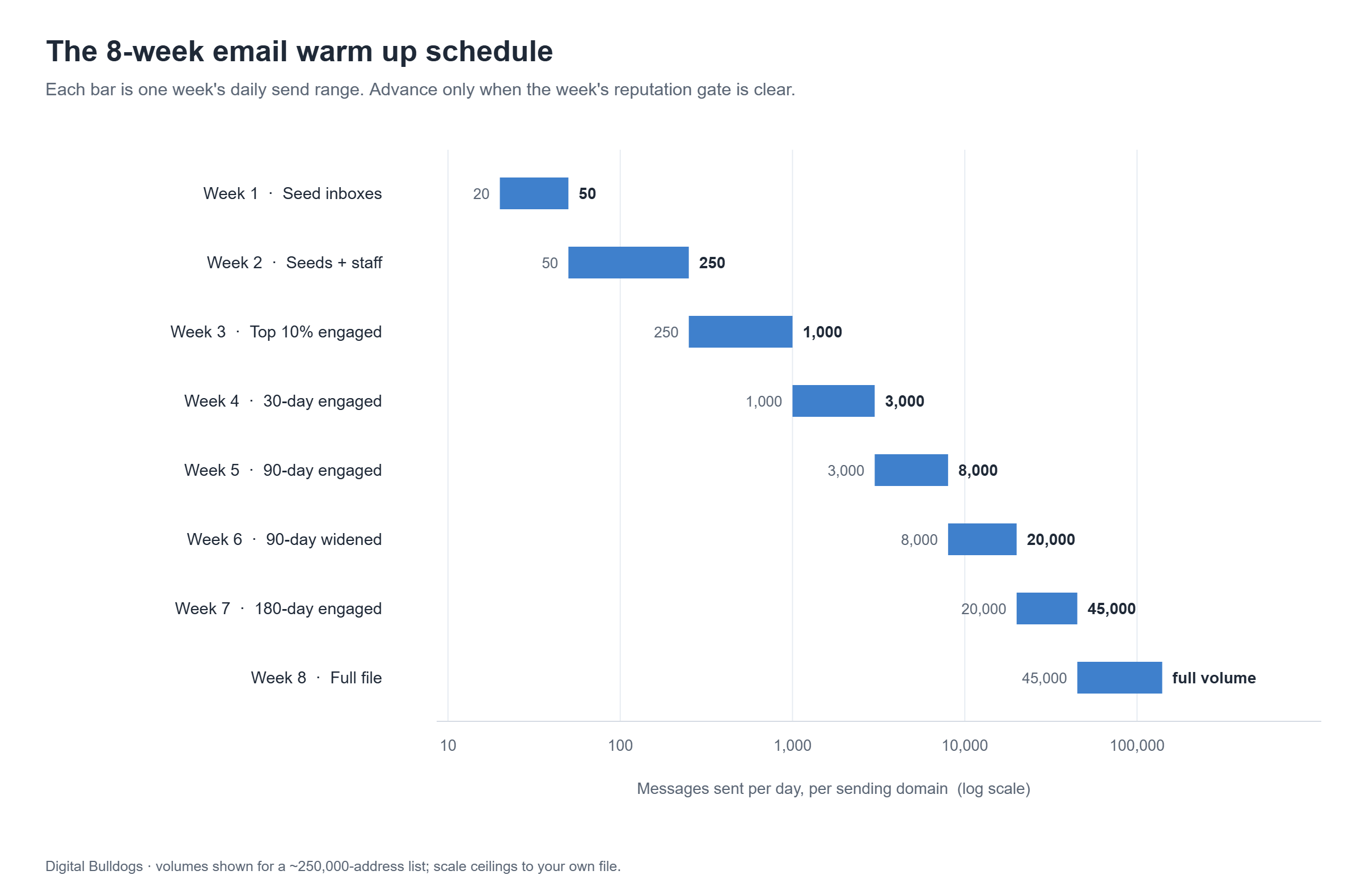
By week four you should be able to judge the email delivery programme on three questions, with data behind each: whether complaints are trending down, whether authentication is passing consistently, and whether placement has moved by provider. If all three are yes, volume keeps rising. If one is no, that becomes the focus rather than a reason to push harder.
What does not happen in 30 days is a full reputation rebuild on a badly damaged domain. Anyone promising that is describing an authentication fix. Real email delivery recovery is measured in weeks of consistent, clean sending, and the honest version of that timeline is what the audit gives you.
Who This Program Is Built For
A fit if you are:
- Sending roughly 50,000+ messages a month with revenue attached to the outcome
- An in-house team, affiliate, agency, or direct-response marketer rather than a hobby list
- Watching inbox placement, open rate, or revenue per send fall without a campaign change
- Launching or reactivating a sending domain and unwilling to gamble the first month
Not a fit if you are:
- Mailing purchased or scraped lists — we will not help unconsented sending land
- Looking for a way around blocklists, filters, or a mailbox provider’s published rules
- Expecting a subscription to fix a domain without anyone doing the work on it
Confirmed Results
✅ Confirmed Results — internal client data
- 94% primary inbox placement — measured across client campaigns monitored in Google Postmaster Tools, Q1–Q4 2025
- $104M+ in client revenue attributed to campaigns delivered through programmes we manage
- 5,077+ active Gmail subscribers in our engagement network — real opted-in people, not automated accounts
- Warming and repairing sending domains since 2011
⚠️ Industry Estimates — third-party benchmarks, not our results
Timelines depend on domain history. A clean new domain typically reaches full volume in six to eight weeks; a previously damaged one routinely takes longer. Google’s published guidance shows how little slack there is — a sender whose complaint rate exceeds 0.30% stays ineligible for mitigation until the rate holds below that line for seven consecutive days.
Named outcomes with starting conditions, interventions, and time frames are on the case studies page.
That is what the audit is for. We look at the domain, the DNS, the reputation grades, and the complaint signals, then tell you what is actually costing you placement — before you commit to anything.
Get My Free Audit →Email Delivery FAQ
How fast can email delivery actually improve?
There are two clocks running, and they move at very different speeds. Authentication is the fast one: SPF, DKIM, and DMARC can be published, aligned, and verified in a matter of days, and senders who were failing outright often see acceptance improve almost immediately once those records pass. Reputation is the slow one, because it is built from history rather than configuration.
Google defines a High domain reputation in its Postmaster Tools documentation as a record of very low spam rates over time — which by definition cannot be earned in a week. In practice, most programmes show measurable movement in placement within the first 30 days and reach a stable, defensible position at six to eight weeks.
Domains carrying prior damage take longer, sometimes ten to twelve weeks, because the old history has to be diluted before the new history counts for much. Anyone promising a fix in days is describing an authentication change, not an email delivery recovery.
What does an email delivery program cost?
Email delivery pricing is scoped to the work rather than quoted off a rate card, because two senders at the same volume can need very different programmes. A clean new domain that needs warming is a much smaller engagement than a domain carrying blocklist history, a decayed file, and three sending subdomains that were never authenticated.
The variables that move the number are sending volume, how many domains and subdomains are in play, the condition of the list, and whether the work is a build or a repair. Everything runs month to month with no long-term contract and no minimum term, which matters more than the headline figure — you are never locked into a programme that is not moving your placement.
The audit comes first and costs nothing. It tells you what is actually wrong, what the realistic timeline is, and what the work would involve, so you can price the decision properly before committing to it.
What makes this different from self-serve warm-up software?
Most warm-up tools enrol your mailbox in a reciprocal network: your account automatically sends to and opens mail from thousands of other accounts inside the same network. The dashboards look excellent, and that is precisely the problem — the accounts moving those numbers are not people.
The metric that gates your delivery at Gmail is the user-reported spam rate, which counts messages that real recipients manually mark as spam. Automated inboxes never file a complaint, so a reciprocal network cannot generate the signal that metric is built from. It manufactures opens while the measurement that actually decides your placement goes untested.
There is a permission dimension too. The M3AAWG Sender Best Common Practices treat consent as the foundation of legitimate sending, and Google’s guidelines say plainly that you should only mail people who asked to hear from you. We seed into real opted-in subscribers because those are the only signals that survive contact with a filter.
Will this work if my domain is already blacklisted?
Usually yes, but the order of operations changes and the timeline stretches. Delisting comes first, and most public blocklists have a request process. The mistake is treating delisting as the fix — if the behaviour that triggered the listing is still in place, the listing comes back, often faster the second time.
So the sequence is: get delisted, remove the cause, then rebuild. The cause is usually one of a small set — a purchased or badly sourced segment, a spike in volume that nothing warranted, broken authentication, or a complaint rate that ran hot for weeks before anyone noticed. Our guide on what to do after a blacklist hit covers the diagnostic steps in detail.
Recovery on a previously damaged domain takes longer than warming a clean one, and in a minority of cases the honest recommendation is to move to a fresh sending domain and warm it properly rather than spend three months rehabilitating one that is not worth saving.
Do you work with all email service providers?
Yes. Reputation attaches to your sending domain and your IP, not to the platform sending on your behalf, so email delivery work is ESP-agnostic by nature. We have run programmes alongside every major sending platform and a number of self-hosted stacks, and the diagnostic and remediation steps do not change between them.
What does change is the tooling available to you. Some platforms expose per-provider engagement and bounce detail readily; others make you work for it or route through shared IP pools where your reputation is partly a function of who else is sending. That affects how we instrument the programme, not whether it works.
If you are weighing a platform migration at the same time, do the reputation work first. Moving ESPs while a domain is in trouble changes one variable and hides another, and you lose the ability to tell which change produced which result. Free diagnostics are in our tools section if you want to look before you talk to anyone.
How do I know if I need this service?
The clearest email delivery signal is a revenue drop with no campaign explanation. Same list, same offers, same send times, and the numbers fall anyway — that is almost always a placement problem rather than a creative one. A Gmail-only decline is even more diagnostic, because it points at one provider’s scoring rather than at your content.
Other reliable indicators: mail arriving in promotions when it used to reach the primary inbox, a domain reputation grade sitting at Low or Medium in Postmaster Tools, bounce rates climbing without a list change, or deferrals and throttling responses appearing in your sending logs. Any one of those is worth investigating; two together usually means the underlying signals have already moved.
If none of that applies and you simply want to send better, start with the free email deliverability guide and the FAQ. Managed work earns its keep when there is real volume and real revenue at stake.
Related Services
- Custom audiences — permission-based reach beyond your own file, for when the constraint is audience size rather than placement.
- Audience data — 1,000+ feeds for append, enrichment, and monetization of a file that has decayed.
- Identity resolution — match and unify records so the file you mail stays current and reachable.
New teardowns and guides go up on the deliverability blog, and the wider practice is introduced on the Digital Bulldogs home page.
Find out what is actually costing you the inbox
A free email delivery audit covering domain, DNS, blocklist status, reputation grades, complaint signals, and placement by provider.
Book a Free AuditFree consultation. No obligation. Month to month, no long-term contract.
Sources & References
- Google — Email sender guidelines — https://support.google.com/mail/answer/81126 — bulk sender authentication requirements and the 0.10% / 0.30% spam-rate thresholds.
- Google — Postmaster Tools dashboards — https://support.google.com/a/answer/14668346 — the definition of a High domain reputation as a record of very low spam rates over time.
- M3AAWG — Sender Best Common Practices, Version 3.0 — https://www.m3aawg.org/documents/en/m3aawg-sender-best-common-practices-version-30 — the industry consent and permission standard for senders.
- IETF — RFC 7489, Domain-based Message Authentication, Reporting and Conformance — https://www.rfc-editor.org/rfc/rfc7489.html — the DMARC specification and its alignment requirement.
About the Team: This page was written and reviewed by the Digital Bulldogs team — email deliverability specialists with 15+ years of hands-on experience in domain reputation repair, inbox placement optimization, and direct-response campaign management. Our team has helped affiliates, agencies, and brands generate over $104M in revenue through compliant, high-deliverability email programs.