
Cold Email for Financial Services: Pre-Send Checks
Before sending cold email for financial services, check who is responsible for the message, whether the actual sending setup is authenticated, what delivery feedback shows, and whether each contact is eligible for outreach. Confirm the applicable financial-services review requirements alongside CAN-SPAM requirements for commercial email, including business-to-business messages: accurate sender information and subjects, advertising identification, a postal address, and a working opt-out process.
Do not treat authentication as proof that a campaign is ready: Google’s sender guidelines also address wanted mail, delivery monitoring, and gradual volume changes. For a FINRA member, check the message’s communications classification and applicable approval, supervision, and recordkeeping requirements. For an investment adviser, determine whether the message falls within the SEC marketing rule’s advertisement definition and restrictions.
This article walks through sender identification, authentication, reputation signals, and contact eligibility before launch. It also explains how to keep enrichment and identity matching separate from permission to send, then bring those checks together in a clear send-or-hold handoff.
Start with sender readiness, not an outreach template
Before sending cold email for financial services, run a send-or-hold review—not just a copy review. Confirm who is sending, which financial communications rules apply, whether the sending setup is authenticated, and whether the recipients are eligible for the campaign. Hold the launch if any of those checks is unresolved.
- Legal requirements: CAN-SPAM covers business-to-business commercial email and requires accurate sender information and subject lines, advertising identification, a postal address, and a working opt-out process. Hiring another company to send does not remove your responsibility. Use the FTC’s CAN-SPAM compliance guide to check these obligations.
- Financial communications review: For FINRA members, classification affects approval, supervision, and recordkeeping under FINRA Rule 2210. For advisers subject to the SEC marketing rule, determine whether the message is an advertisement; individual communications have an exclusion with exceptions involving hypothetical performance. The SEC’s marketing rule guide explains the scope and misleading-advertisement restrictions.
- Mailbox-provider expectations: Check authentication on the actual sending setup. Google’s sender guidelines set authentication requirements, recommend sending to subscribers who want your messages, and advise monitoring delivery and increasing volume gradually. Technical readiness is not approval for unsolicited outreach.
- Operational recommendation: Record a send-or-hold decision covering sender identity, required review, authentication, and recipient eligibility, including opt-outs. Keep legal compliance and provider acceptance as separate checks; neither guarantees inbox placement.
If the blocker is authentication or delivery configuration rather than legal eligibility, a free Digital Bulldogs email deliverability consultation is an optional next step.
Identify the sender and the email rules that apply
Start by identifying whose services the email promotes and who is responsible for sending it. An agency pitching its own services to a financial firm needs a different review from a regulated firm promoting investment services. The recipient’s industry alone does not determine which rules apply.
- For commercial outreach: The FTC’s commercial email guidance covers business-to-business messages. It calls for accurate sender information, nondeceptive subject lines, clear advertising identification, a valid postal address and an accessible opt-out method. Hiring an agency to send the email does not remove the promoting business’s responsibility.
- For FINRA member firms: FINRA’s communications rule distinguishes correspondence, retail communications and institutional communications, with different approval, supervision and recordkeeping requirements. Do not classify a contact as an institutional investor simply because they work in financial services; that classification must meet the rule’s definition.
- For investment advisers: The SEC’s investment adviser marketing guide addresses advisers registered or required to register with the SEC and advertisements they disseminate. Its exclusion for individual communications has exceptions involving hypothetical performance, so a personalized email is not automatically outside the marketing rule.
Before launch, record the promoting business, the sending party and the applicable review owner. Route regulated financial promotions through the firm’s required review process before handing them off for delivery. This deliverability workflow is not legal advice or a complete account of financial advertising obligations.
Authenticate the actual sending setup
Before releasing a campaign, the financial brand and its sending partners should verify authentication on the infrastructure that will actually send it—not just the company’s employee mailboxes.
The Gmail sender guidelines distinguish general requirements from additional bulk-sender requirements for messages sent to personal Gmail accounts. General senders must use SPF or DKIM. Bulk senders must use SPF, DKIM and DMARC, with the From domain aligned with either the SPF domain or the DKIM domain so that DMARC can pass.
Make that review specific to each sending route:
- Identify the platform and domain. Document which system sends the campaign, which domain appears in the From address, and who controls the relevant DNS records.
- Check the live message. Review authentication results in a test message sent through the actual campaign platform. Confirm the required SPF, DKIM and DMARC checks, including alignment where required, rather than relying only on a platform’s setup screen.
- Include sending partners. Review agency platforms, affiliate infrastructure and any other service sending for the brand. Authentication on the employee mailbox does not establish that these separate routes are configured correctly.
- Resolve gaps before release. Assign a responsible person to correct missing records, failed authentication or alignment problems before approving that sending route.
Where partners manage their own systems, a shared checklist for email authentication for affiliates and lead generators can help keep the handoff clear. Authentication is a launch prerequisite, not a promise of inbox placement.
Read delivery feedback before increasing volume
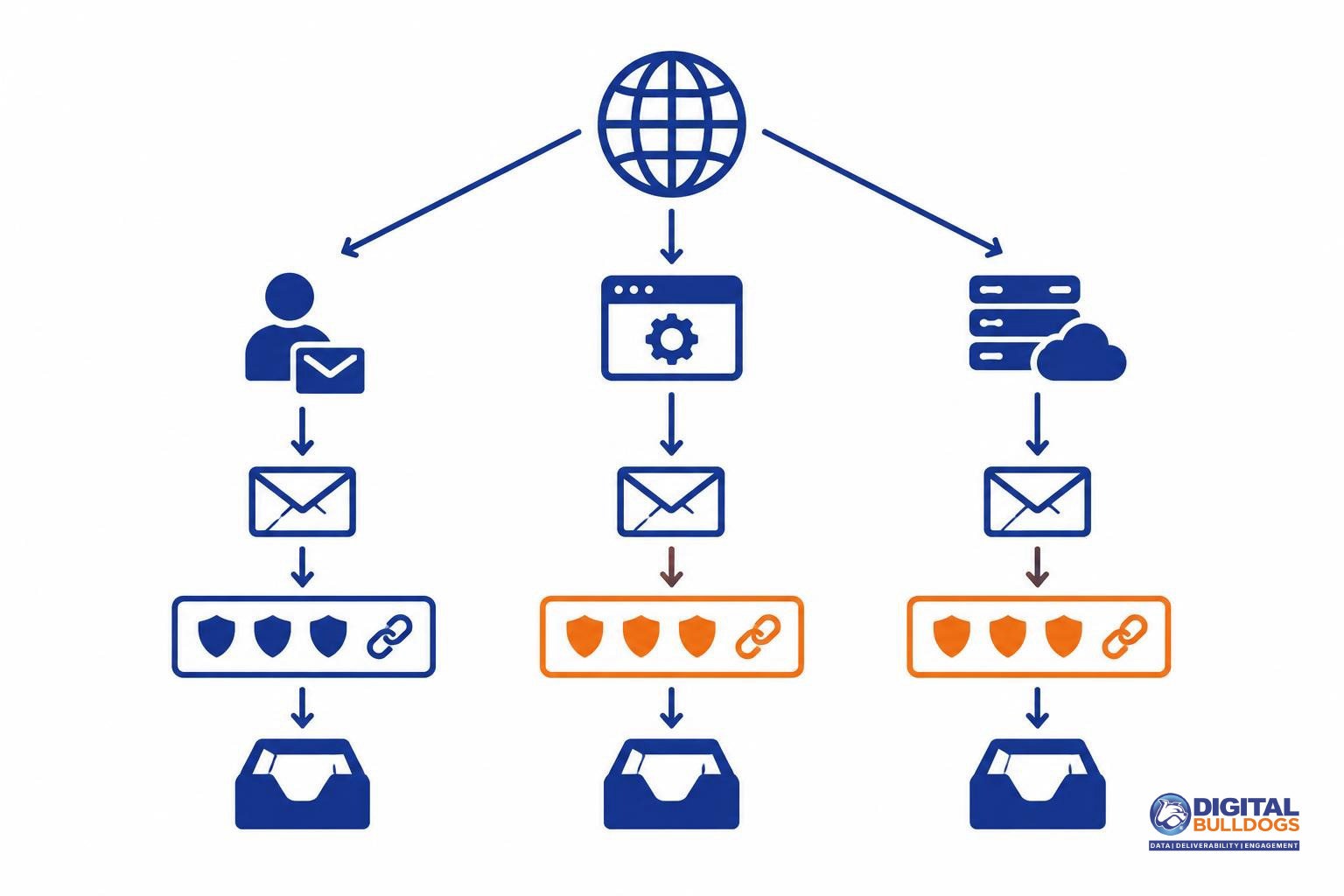
Increase volume only after reviewing how the current traffic is performing. For a financial-services campaign, successful submission to a sending platform is not enough to justify a larger send.
Google’s sender guidelines recommend consistent sending, gradual volume increases and monitoring server responses, spam rates and domain reputation. Google also cautions that open rates are not a reliable indicator of deliverability. Do not treat opens alone as proof that messages reached the inbox.
Keep feedback grouped by sending platform and recipient provider. That gives your agency a useful investigation path: a problem affecting Gmail traffic from one platform should not disappear inside a campaign-wide average.
- Continue cautiously: Authentication checks pass, delivery responses remain stable and reputation and complaint signals show no deterioration. Maintain a consistent sending pattern rather than introducing a sudden spike.
- Reduce volume: Deferrals, temporary failures or complaints begin increasing. Slow the affected traffic and review what changed before attempting another increase.
- Investigate before expanding: Authentication failures, repeated rejections or worsening reputation need a clear explanation. Review bounce and deferral messages for the affected platform and provider instead of assuming every failure means an invalid address.
For each sending stream, record authentication results, available reputation signals, complaints, bounce and deferral responses, and the action taken. Include recent changes to the sending setup, audience or cadence. This turns monitoring into a practical handoff: continue gradually, reduce the affected volume, or hold expansion while the agency investigates.
Check contact eligibility before building the audience
Decide whether each contact belongs in this sender’s campaign before adding it to the audience. A valid address alone does not establish permission to send, a relevant relationship or suitability for a financial offer.
Keep the information needed for that decision alongside each contact:
- Source history: Where the address came from, when it was collected and which business collected it.
- Recipient expectations: What the person requested or was told to expect, and whether that matches the proposed sender and message.
- Opt-out status: The applicable suppression records, including any unresolved differences between systems or sending partners.
Under the FTC’s CAN-SPAM guidance, commercial business-to-business email is covered, and businesses cannot sell or transfer opted-out addresses except to a company hired to help comply with the law. Check suppression status before audience export, not just during the final send.
Legal compliance and recipient expectations are separate checks. Meeting CAN-SPAM requirements does not replace Google’s recommendation to send messages only to people who want them. An address appearing in a database does not, by itself, show that the recipient expects this campaign.
Put records with unresolved provenance, conflicting suppression history or an unclear relationship to the campaign into a review queue. Hold them out of the launch audience until the issue is resolved.
Use address validation to identify operational quality problems—not to approve permission or financial suitability. Keeping that distinction clear is central to contact data quality and mailable records: a technically usable address still needs a campaign-specific eligibility decision.
Keep enrichment and identity matching separate from send approval
Use audience data to organize an existing business file, not to turn a contact into an approved recipient. Relevant company and role attributes can help you group contacts for review and build narrower segments. An appended attribute is not permission to email.
For example, B2B and first-party data append can support segmentation by company or role, while a separate eligibility review determines whether each contact belongs in the send audience.
Keep matched attributes separate from the original contact history so reviewers can see both why someone was selected and why they may need to stay excluded:
- Original history: Preserve the source of the contact, prior email addresses, opt-out status and other suppression reasons.
- Matched attributes: Record the added company or role information, its source and when it was added, without overwriting the contact history.
- Send decision: Maintain a separate approval or hold status, with a visible reason for the decision.
Adopt a conservative operational rule: an import, corrected address or identity match must not automatically reactivate a suppressed contact. If a match connects records with conflicting eligibility statuses, hold the contact for review rather than letting the newest data win.
This separation also matters when sharing data. The FTC’s CAN-SPAM guidance says that once someone opts out, you cannot sell or transfer their email address, even as part of a mailing list. Its stated exception allows transfer to a company hired to help comply with CAN-SPAM. Enrichment should preserve that restriction, not quietly remove it.
Use a send-or-hold handoff before launch
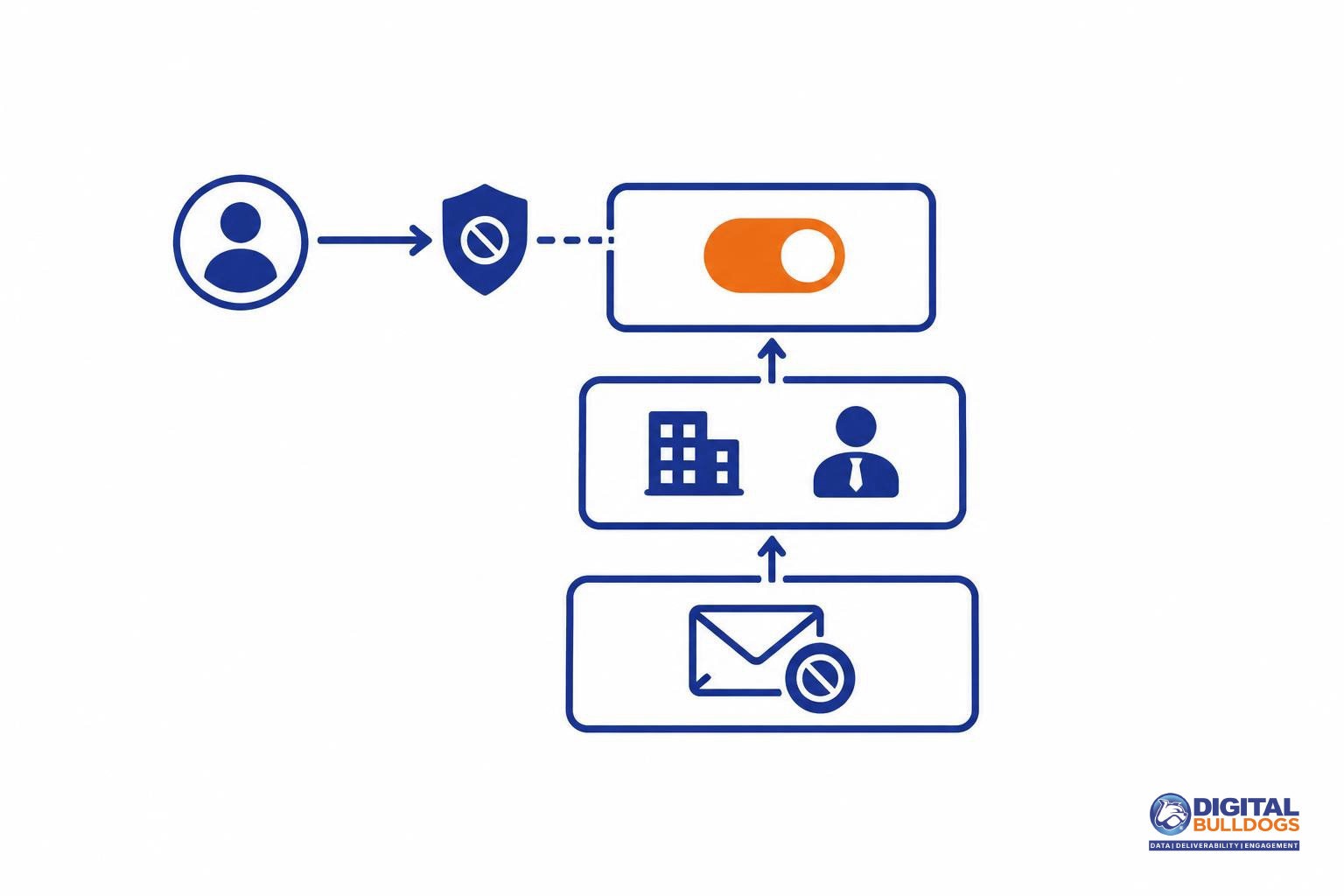
Before launch, give each pre-send check a named owner and a clear outcome: send or hold. An agency’s technical sign-off should not stand in for the client’s audience approval or financial communications review.
- Domain configuration: Assign a technical owner to confirm authentication for the actual sending setup and document unresolved delivery or reputation issues. Google’s sender guidelines describe authentication requirements and recommend monitoring delivery feedback and increasing volume gradually.
- Recipient selection: Have the audience owner record why contacts qualify for this campaign and confirm that applicable suppression records have been applied. Keep enrichment and identity-match findings separate from the decision to send.
- Financial communications review: Name the client’s compliance reviewer. For FINRA members, Rule 2210 sets different approval, supervision and recordkeeping provisions by communication category. For advisers subject to the SEC marketing rule, the advertisement definition, content restrictions and associated records also need consideration.
- Opt-out processing: Assign responsibility for receiving requests, updating suppressions and passing changes between agency and client. Under the FTC’s CAN-SPAM guidance, hiring another company to send does not remove the promoted business’s responsibility for compliance.
Hold the affected campaign when authentication is unresolved, required review is incomplete or suppression handling is unreliable. Keep the approved message, audience selection rationale, technical findings and sign-offs together in the launch handoff so the sending team knows exactly what was cleared.
If authentication or sender reputation remains unresolved, book a free consult with Digital Bulldogs for help with the sending setup and delivery diagnostics. Keep financial regulatory interpretation with qualified counsel or the firm’s compliance team.
Frequently asked questions
Does CAN-SPAM apply when the recipient is another financial business?
Yes. CAN-SPAM covers commercial email sent to businesses, not just consumers. The FTC’s compliance guide requires accurate sender information and subject lines, advertising identification, a valid physical postal address and a clear way to opt out. Before sending, check the message and suppression process rather than treating a business address as an exemption.
Does passing SPF, DKIM and DMARC guarantee inbox placement?
No. Authentication is a sending requirement, not a promise of inbox placement. Google’s sender guidelines also emphasize wanted messages, sender reputation, delivery monitoring and gradual changes in sending volume. Before increasing volume, review delivery errors and spam feedback alongside authentication results. A passing authentication check alone is not a sound reason to scale a campaign.
Does FINRA require the same review process for every financial email?
No. For FINRA members, the applicable process depends on how the communication is classified. FINRA Rule 2210 distinguishes correspondence, retail communications and institutional communications, with different approval and supervision provisions. Before launch, have the responsible reviewer classify the audience and message. An email sent to a financial business should not automatically be treated as an institutional communication without checking the rule’s definitions.
Is an individually addressed investment adviser email always outside the SEC marketing rule?
No. Addressing an email to one person does not settle whether it is an advertisement. The SEC’s investment adviser marketing guide explains that one-on-one communications are generally excluded from the advertisement definition, but hypothetical-performance communications have special treatment and limited exceptions. Check the content and circumstances, not just the recipient count, before deciding which marketing-rule review and recordkeeping requirements apply.
Can an agency take over all responsibility for commercial email compliance?
No. Under the FTC guidance cited above, a business cannot contract away its legal responsibility for CAN-SPAM compliance. Both the company whose product is promoted and the company sending the message may be responsible. A practical handoff should identify who checks sender details, the postal address, unsubscribe handling and suppression lists—and who gives final send approval.
Sources
- CAN-SPAM Act: A Compliance Guide for Business · Federal Trade Commission
- Email sender guidelines · Google
- 2210. Communications with the Public · Financial Industry Regulatory Authority
- Investment Adviser Marketing · U.S. Securities and Exchange Commission · 2021-04-28