What Is an Identity Graph? How They Work and Where They Break

An identity graph is the part of an audience data stack that people buy without ever seeing. You are told your records were unified; what you actually bought was a set of decisions about which records belong to the same person, made by a system you cannot inspect. This covers what a graph stores, how its connections get made, where it stops working, and the questions that separate a real graph from a lookup table with a better name.
Quick answer: what is an identity graph?
An identity graph is a database that stores identifiers as nodes — email addresses, phone numbers, postal addresses, device and cookie IDs, customer account numbers — and the connections between them as edges, where each edge is an assertion that two identifiers belong to the same person or household. Its value is not the number of identifiers it holds but the quality and auditability of those edges. A graph that cannot tell you why two records were joined is not a graph you can defend to a regulator or debug when a campaign underperforms.
Nodes, edges, and why the edges are the product
The nodes are the easy part. Any identifier a person leaves behind can be a node: a hashed email, a phone number, a postal address, a mobile advertising ID, a cookie, a logged-in account ID, a loyalty number.
The edges are where the judgement lives, and where vendors differ enormously while describing themselves identically. An edge says “these two nodes are the same person.” That claim can be made on solid ground or on a guess, and a graph typically contains both kinds without labelling which is which.
This is why database size is close to a meaningless figure on its own. A graph with a billion nodes and carelessly built edges will confidently merge two different people who share a household IP address. A smaller graph with verified edges will not. The headline number describes the nodes; your results depend on the edges.
How edges get built
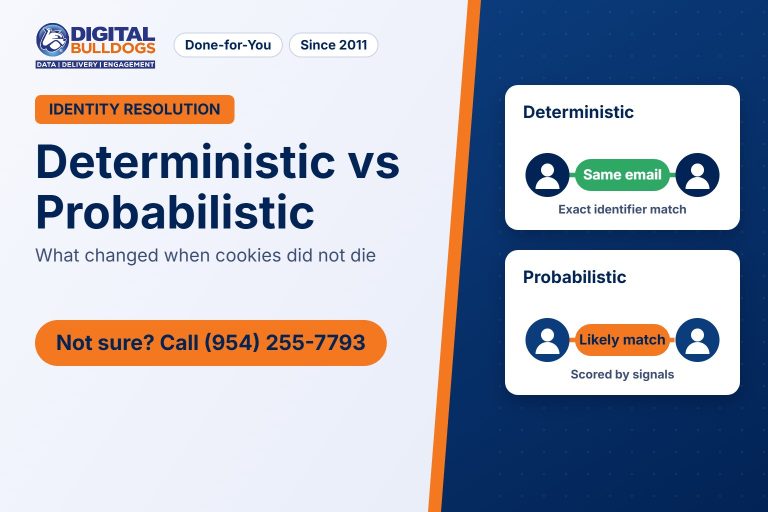
Two mechanisms, and the distinction matters enough that we wrote it up separately in deterministic vs probabilistic identity resolution. In graph terms:
Deterministic edges come from a shared, stable, person-level identifier. IAB Tech Lab’s Identity Solutions Guidance describes these identifiers as attributes that are “relatively permanent and associated with one person or household,” naming email address, phone number and home address. Someone logged in on their laptop and their phone with the same account creates a deterministic edge between those two devices. The assertion is auditable after the fact: you can show which identifier was shared.
Probabilistic edges are inferred from circumstantial signals. The same IAB guidance lists IP address, user agent, timestamps, and device details or settings, and is candid that these methods “allow marketers to achieve greater scale, with potentially less precision.” Crucially, it notes they rely on “relatively temporary attributes or attributes that change often” — which means probabilistic edges decay on their own, without anything in your data changing.
Most production graphs are a blend. That is not inherently a problem. The problem is a blend presented as if it were uniformly deterministic, because then every edge inherits the credibility of the strongest ones.
The scale ceiling nobody advertises
Deterministic edges require someone to have identified themselves. Most of the web never asks. IAB Tech Lab puts a figure on it: “only about 10%-20% of ‘open-web’ content sits behind an authentication wall.”
That single sentence explains the entire shape of the identity market. Outside that slice there is no shared email address to join on, so coverage beyond it has to come from inference. It also gives you a sanity check you can apply in any vendor conversation: if the claimed coverage of open-web traffic is very high and the method is described as deterministic, one of those two claims is doing work it has not earned. Ask which.
Household versus individual: the error that looks like a win
Graphs resolve to different levels, and a vendor that does not tell you which level you are buying is selling you an ambiguity. Household resolution groups everyone at an address or behind a shared connection. Individual resolution separates them.
Household-level edges inflate coverage statistics pleasantly and then misfire in ways that are hard to attribute. Two adults sharing a home and a router look like one person to an IP-based edge. Suppress one of them and you may suppress both; target one with a product the other bought and the campaign reads as poorly targeted rather than wrongly resolved. For suppression and preference management in particular — the cases where being wrong has consequences rather than just costing a click — individual resolution is the thing you actually need, and it is the harder and smaller of the two.
What happened to the industry’s shared plumbing
Identity graphs were widely pitched as the answer to third-party cookies disappearing. That framing is now out of date and the actual situation is more awkward.
In April 2025 Google said it would “maintain our current approach to offering users third-party cookie choice in Chrome, and will not be rolling out a new standalone prompt for third-party cookies.” In October 2025 it retired the Privacy Sandbox technologies built as replacements, among them Topics, Protected Audience, the Attribution Reporting API, Private Aggregation and IP Protection. Meanwhile Apple’s WebKit documentation states that Intelligent Tracking Prevention “by default blocks all third-party cookies. There are no exceptions to this blocking,” and Mozilla’s documentation describes Firefox’s Total Cookie Protection, on by default, as giving “third-party cookies a separate cookie jar per site, preventing cross-site tracking.” Chrome, per that same Mozilla reference, “doesn’t block third-party cookies by default.”
So cookies did not vanish and the standardised alternative no longer exists. Cookie-based edges now work fully in one browser, are partitioned into uselessness in another, and are blocked in a third — which makes a graph’s cookie-derived edges reliable in proportion to a browser mix you do not control. Edges built on verified first-party identifiers behave identically everywhere, because they are not browser artefacts. That is a real argument for deterministic edges, and it is not the argument the cookieless pitch was making.
A graph has to answer for itself legally
Under the California Consumer Privacy Act, as summarised by the state Attorney General, consumers can request disclosure of what personal information a business has collected, used, shared or sold about them, request deletion, correct inaccurate information, and opt out of the sale or sharing of their data, with businesses required to respond within 45 days. A graph is specifically a system for creating a fuller picture of a person than any single source held, which makes it exactly the thing such a request is about.
This is the requirement that quietly rules out a lot of architectures, and it is rarely in the sales deck. To satisfy it you need to know which nodes were joined to which, and on what basis — not merely that a cluster exists. A probabilistic graph that cannot reconstruct why two records were merged cannot cleanly honour a deletion request, because it cannot establish the boundary of the person. And if your graph contains business contacts, note that the California Privacy Protection Agency states “the exemptions for employment-related personal information and personal information reflecting business-to-business transactions described in Civil Code Sec. 1798.145(m)-(n) expired on December 31, 2022.” Business records in the graph carry the same obligations as consumer ones.
One more boundary worth stating plainly: resolving an identity is not permission to use it. M3AAWG’s position on email appending is that consent given in one context does not extend to another, and that sending to someone who never gave informed consent for their address to be used that way “is never acceptable.” A graph can tell you two records describe one person. It cannot tell you that person agreed to hear from you.
Six questions that tell you what you are buying
Ask these of any identity graph, ours included, and the answers will be more informative than any coverage figure. What proportion of edges are deterministic versus probabilistic, and can individual edges be labelled by method rather than the system being described in aggregate. What are the deterministic match keys, specifically. Does the graph resolve to individual or household, and can it do both on request. How often are probabilistic edges rebuilt, given that they rest on attributes IAB Tech Lab calls “relatively temporary”. Can the graph support a deletion or correction request traced to one person. And what is the consent and provenance basis of the underlying records, evidenced per source rather than asserted across the file.
A vendor who answers all six crisply and then quotes one match rate that holds across every vertical and file condition has contradicted themselves, because match rates move with file age, match key, record completeness and the attributes requested. The willingness to name a limitation is the signal worth buying.
Frequently asked questions
Is an identity graph the same as a CDP?
No, though they are often sold together. A customer data platform collects, stores and activates customer data. An identity graph is the resolution layer that decides which of those records belong to the same person. A CDP may contain a graph, use an external one, or do little more than exact-match on email and call it resolution — which is worth establishing before assuming the capability is there.
How is an identity graph different from identity resolution?
Identity resolution is the process of working out that two records describe one person. The graph is the structure that stores those conclusions so they can be reused. Resolution is the verb and the graph is the noun. Our identity resolution service is the former; the graph is what it builds.
Do I need an identity graph if I only email?
Probably not a cross-device graph. If every interaction happens through one email address you already have a stable person-level identifier, and your problems are more likely list condition and sending reputation than resolution. A graph starts earning its cost when the same person reaches you through several identifiers — web, email, phone, offline, connected TV — and you need to avoid treating them as several people.
Can an identity graph be built from first-party data alone?
Yes, and it will be your most defensible one, because you can evidence the provenance of every node. It will also be limited to the identifiers your own customers have given you, which is why most organisations supplement it. Starting first-party and extending outward is the right order; it is also the order that keeps the compliance story simple.
How quickly does a graph go stale?
Unevenly, which is the difficulty. Deterministic edges on email or postal address age slowly. Probabilistic edges built on IP addresses, user agents and device settings can be wrong within weeks, and nothing in the output marks them as newly wrong. That asymmetry is why refresh cadence is a better question than database size.
Where this fits
Digital Bulldogs builds identity resolution on deterministic edges, uses probabilistic signals only where they are appropriate, and says which is which — for the reasons above rather than because cookies were supposed to disappear. The same records sit behind our audience data services, consumer and demographic append, B2B and first-party append, and the custom digital audiences built on top of them. If the resolved audience is going to be emailed, list hygiene is what keeps the deliverable addresses deliverable.
If you want to know whether a graph would help your data or whether your problem lies elsewhere, book a free consultation. We will tell you plainly, including when the honest answer is that you do not need one.
Sources
- IAB Tech Lab, Identity Solutions Guidance v1.0 — definitions of deterministic and probabilistic identifiers, the scale-versus-precision trade, and the 10-20% authentication-wall figure.
- Google, Next steps for Privacy Sandbox and tracking protections in Chrome (22 April 2025) — Chrome retains third-party cookie choice; no standalone prompt.
- Google, Update on Plans for Privacy Sandbox Technologies (17 October 2025) — the retired technologies, including Topics and Protected Audience.
- Apple WebKit, Tracking Prevention — ITP blocks all third-party cookies by default, with no exceptions.
- MDN, Third-party cookies — Firefox partitions third-party cookies per site; Chrome does not block them by default.
- California Attorney General, California Consumer Privacy Act (CCPA) — rights to know, delete, correct and opt out, and the 45-day response requirement.
- California Privacy Protection Agency, Frequently Asked Questions — the business-to-business and employment exemptions expired on 31 December 2022.
- M3AAWG Position on Email Appending — consent does not transfer between channels.