
Lead Identification vs Lead Qualification: Data vs Fit
The difference in lead identification vs lead qualification is finding potential customers versus assessing whether they are a good fit and have a reason to act. Identification establishes who might buy; qualification evaluates factors such as fit, interest, and timing to help decide what should happen next.
This article explains what each step involves, where enrichment and identity resolution fit, and what marketing should pass to sales. It also separates sales readiness from email-data checks, so you can choose the next step based on what is missing: contact details, qualification evidence, or a cleaner email list.
What is the difference between lead identification and lead qualification?
Lead identification finds and records potential customers; lead qualification evaluates whether those prospects fit the offer and are ready for a sales next step. Identification answers “Who might buy?” Qualification asks “Is this a relevant opportunity to pursue now?”
Microsoft’s lead-management documentation treats identification and enrichment as activities that precede qualification, where teams assess fit, interest, and timing. The distinction is between collecting information about a potential buyer and using that information to decide what should happen next.
| Activity | Question asked | Evidence collected | Decision produced |
|---|---|---|---|
| Lead identification | Who might be a customer? | Contact and company details, lead source, and relevant background information. | Whether to create or enrich a lead record for further assessment. |
| Lead qualification | Does this prospect fit, show interest, and have a relevant timeline? | Information about needs, fit with the offer, expressed interest, and timing. | Whether to pursue a sales next step, continue nurturing, or stop pursuing the lead. |
Identifying someone does not, by itself, establish sales readiness. A record may tell you who a person is and where they work without showing whether they need your service or want a sales conversation. Treating the activities separately helps keep a newly captured contact from being mistaken for a qualified opportunity.
Lead identification: Who might be a customer?
Lead identification means finding a person or company worth investigating as a potential customer. It gives your team a starting point—not proof that someone needs your service or is ready to buy.
Start with the places where potential customers already appear: campaigns, events, inbound inquiries, referrals, website interactions, and existing business records. Microsoft’s lead-management workflow describes gathering leads from multiple sources and enriching those records before assessing their fit, interest, and timing.
A useful initial record should preserve what you know and how you learned it. As a practical checklist—not a required industry format—consider recording:
- Company: The business associated with the lead.
- Person, when known: A named contact, rather than an assumed buyer.
- Role: The person’s job title or function, leaving it unknown if it has not been established.
- Source: Where the record came from, such as an event, referral, or inquiry.
- Observed interaction: What actually happened, such as a submitted question or event conversation. Keep observation separate from assumptions about intent.
Make account identification and person identification explicit. Finding a relevant company does not mean you have found a specific buyer. Label an account-only record accordingly, and distinguish a known contact from someone whose buying responsibility still needs checking.
The output is a potential customer to investigate. Salesforce distinguishes generating and capturing leads from assessing needs, budget, buying authority, and fit. Those later checks help determine whether an identified lead merits a sales conversation.
Lead qualification: Is there a fit and a reason to act?
Lead qualification asks whether a potential customer has a need your offer can address—and whether there is a realistic path toward a buying decision. Identifying a person or company gives you a record to investigate; qualification adds evidence for deciding what to do next.
Salesforce’s qualification guidance covers assessing needs, budget, buying authority, and product or service fit. In discovery, turn those areas into straightforward questions:
- Need: What problem needs solving, and why does it matter?
- Fit: Can this offer address that problem?
- Decision process: Who participates in the decision, and what role does each person play?
- Resources and timing: What budget, staff capacity, and timeline are realistic?
Microsoft’s lead-management documentation also includes interest and timing in qualification, alongside scoring and nurturing. A relevant problem is useful evidence, but it does not by itself establish that the prospect wants to explore a solution now.
Record what you learn, including what remains unknown. A job title is not confirmation of purchasing authority, and company size is not confirmation of available budget. When an answer is missing, note the question and how you plan to verify it rather than filling the gap with an assumption.
Scoring can help prioritize follow-up, while nurturing can keep the conversation open when interest or timing is still developing. Neither should hide the underlying evidence. Keep the answers, gaps, and agreed next step visible beside any score; use criteria that suit your sales process rather than treating one threshold or qualification framework as mandatory.

Where enrichment and identity resolution fit
Enrichment and identity resolution help make lead records more useful. They do not, by themselves, show that someone is ready to buy.
B2B and first-party data append can add company and professional attributes to existing records, such as industry, location, department, and job title. Digital Bulldogs describes this as enriching existing relationship-based records—not supplying cold-email lists disguised as enrichment.
Those attributes can help you decide what to ask next. Industry and location may help assess whether an account falls within your target market. Department and job title can suggest which business needs to explore. But an appended job title is not the same evidence as a buyer confirming their decision-making role. Salesforce’s guidance treats needs, budget, buying authority, and product or service fit as qualification considerations; a more complete record does not answer all of them.
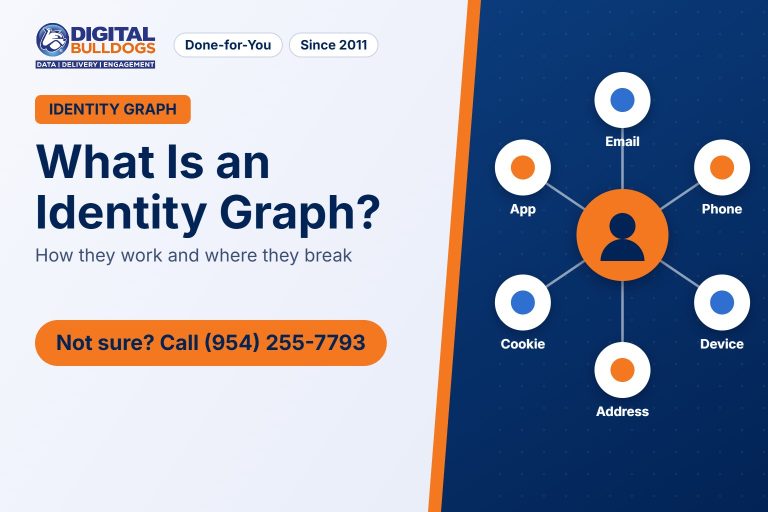
A useful distinction is this: identity work asks which records belong together; qualification asks whether the prospect meets your business’s sales criteria. For the matching mechanics, see how deterministic and probabilistic identity matching differ.
Microsoft’s documented workflow places identification and enrichment before qualification. Treat that supporting data as preparation for assessing fit, interest, and timing—not as a substitute for that assessment.
What to include in the marketing and sales handoff
A useful handoff explains who the lead is, what is known, and why a particular next step makes sense. We recommend this checklist rather than passing along a contact record with a status label alone:
- Identified person or account: Record the name, company, role, and associated account where known.
- Source: Note where the record came from and how it entered your workflow.
- Relevant fit attributes: Include the company or professional details that matter to your offering, with their source.
- Observed interest: Describe the actual action, such as an inquiry or meeting request, without treating it as proof of purchase intent.
- Confirmed qualification answers: Capture what the buyer has confirmed about needs, budget, buying authority, and fit—areas included in Salesforce’s qualification guidance.
- Unresolved questions: Mark unknowns explicitly instead of filling gaps with assumptions.
- Owner: Name the person or team responsible for follow-up.
- Next action and reason: Specify whether to advance, nurture, or disqualify the lead, and explain the evidence behind that recommendation.
Keep buyer statements, observed actions, and inferred attributes separate. “Buyer confirmed a project” carries a different meaning from “company appears to match our target profile.” The receiving team should be able to distinguish evidence from interpretation.
Microsoft’s lead-management workflow illustrates responsibilities across marketing, sales, and sales operations: marketing supports identification and nurturing, sales assesses and qualifies opportunities, and sales operations supports the process and systems. Treat that as an example, not a universal staffing rule. Whatever your structure, assign ownership and preserve the reason for each status change.

Sales readiness does not replace email checks
A lead can be a strong sales fit without being ready for email outreach. Sales qualification evaluates the opportunity: whether the prospect’s needs and circumstances make a conversation worthwhile. By contrast, list management and hygiene addresses invalid and risky email records. These are separate checks; a promising opportunity does not establish that its email record is suitable to use.
Enrichment answers another question: what useful information is missing from an existing record? Digital Bulldogs’ B2B and first-party data append service adds company-level and professional attributes to existing records rather than supplying cold-email lists as enrichment. Adding those details does not itself establish permission to contact someone, and meeting sales criteria is not legal clearance to send.
FTC guidance on CAN-SPAM covers commercial email and makes no exception for business-to-business email. Its requirements include:
- Accurate sender and routing information.
- Subject lines that are not deceptive.
- Required identification of the message as an advertisement and a valid physical postal address.
- A clear way to opt out of future marketing email, with opt-out requests honored.
Keep opportunity assessment, email-data checks, and sending obligations separate in your workflow. A positive answer in one area does not resolve the others. These federal requirements are not a complete assessment of every privacy or outreach requirement that may apply.
Choose the next step based on what is missing
The next step depends on the gap: research helps you identify a prospect, enrichment fills missing record details, qualification tests the fit, and email-data checks help you decide which addresses need attention before sending.
- You do not know who the prospect is. Start with research. Establish which person or company you are looking at and why they might belong in your target audience before treating the record as a potential opportunity.
- You know the prospect, but the record is incomplete. Consider enrichment. Digital Bulldogs’ B2B and first-party data append services add company-level and professional attributes to existing records. Use those details to inform your next question—not to assume a buying decision.
- You still have unanswered qualification questions. Investigate the buyer’s needs, budget, authority, and timing through further research and conversation. An enriched record alone does not confirm those answers or establish intent.
- You have email-data concerns. Address them before sending. Digital Bulldogs’ list management and hygiene services cover invalid and risky email records. Keep that maintenance separate from judging whether someone is a good sales prospect.
If incomplete audience records, identity-resolution questions, or email-data issues are holding up your next step, book a free consult with Digital Bulldogs. Bring the gaps you need to resolve so the conversation can focus on whether data append, identity resolution, or list hygiene is relevant to your situation.
Keep researching on Digital Bulldogs
Frequently asked questions
Which comes first: lead identification or lead qualification?
Lead identification comes first: establish who might be a customer before deciding whether there is a realistic sales opportunity. In Microsoft’s documented lead-management workflow, identification and enrichment precede qualification, which considers fit, interest, and timing. Keep those decisions separate: finding a relevant person or company is a starting point, not a reason to mark the lead ready for sales.
What information should I collect when identifying a lead?
Start with the person’s name, company, professional role, contact details, and where the record came from. Add company attributes relevant to your offering, and flag missing or uncertain fields rather than guessing. Digital Bulldogs’ B2B data append service focuses on adding company-level and professional attributes to existing records, not supplying cold-email lists. Keep identification fields separate from later notes about needs or buying readiness.
Does enriching a lead automatically make it qualified?
No. A more complete record does not, by itself, establish a buying opportunity. Salesforce’s qualification guidance calls for assessing needs, budget, buying authority, and product or service fit. Use enriched details to prepare better questions and check relevance, then confirm the information needed for a qualification decision rather than treating filled-in fields as proof of interest.
Can lead scoring replace lead qualification?
No—use scoring to decide which leads to review next, not as your final acceptance decision. Before handing a lead to sales, check the evidence behind the score: What need has been confirmed? Who is involved in the decision? Is there a reason to act now? Set an explicit handoff rule, and leave unresolved questions visible instead of letting a score stand in for answers.
Can a qualified B2B lead still require email-hygiene and compliance checks?
Yes. Sales fit, email-data quality, and compliance are separate checks. Digital Bulldogs’ list hygiene services address invalid and risky email records, not buying readiness. The FTC’s CAN-SPAM guidance also makes clear that commercial B2B email is covered: requirements include accurate headers and subject lines, advertising identification, a postal address, an opt-out mechanism, and honoring opt-out requests. Qualification does not remove those obligations.
Sources
- Create well-run lead management with the identify and qualify leads business process area · Microsoft Learn · 2025-09-23
- CAN-SPAM Act: A Compliance Guide for Business · Federal Trade Commission
- B2B and First-Party Data Append: Firmographic Enrichment That Holds Up · Digital Bulldogs
- List Management & Hygiene Services · Digital Bulldogs
This article is general information, not legal advice. Laws and deadlines vary by state and change over time; check the linked sources or speak with a licensed attorney about your situation.





One Comment