
Email Append Match Rate: What Vendor Numbers Really Mean
An email append match rate tells you the share of submitted records a vendor reports linking to an email address—not whether those links are correct or ready for outreach. To judge accuracy and usability, ask how the vendor defines a match, test a sample for incorrect person-to-address links, and assess permission and sending readiness separately: data-linkage guidance distinguishes match coverage from match accuracy, while M3AAWG warns that appended addresses can involve incorrect identity links and lack channel-specific permission.
This article explains how your input file, matching methods and confidence thresholds shape the reported result—and why a higher rate can hide weaker matches. You’ll also learn what to check in a sample and which questions to ask before approving a full append, keeping identity accuracy separate from authentication, recipient expectations and sender reputation.
What an email append match rate actually measures
An email append match rate is the share of records a vendor classifies as matched under its stated rules. It tells you how much of your file met that definition—not whether every address belongs to the intended person, is a valid mailbox, carries permission to email, or is ready for inbox delivery.
Before comparing audience data append services, ask the vendor to explain both sides of its calculation in plain language:
- Denominator: What went into the calculation? All submitted rows, or only eligible unique records after exclusions?
- Numerator: What counted as a match? Records with any candidate email address, or only records passing your agreed acceptance rules?
- Duplicates and missing inputs: Are repeated records counted separately? Are records missing required identifiers excluded or counted as unmatched?
- Existing emails and suppressions: Do records that already contain an email address count toward results? Are suppressed records removed before or after the rate is calculated?
- Multiple candidates: Does a record count once regardless of how many addresses are returned, and what determines which address is accepted?
Use these questions as a comparison checklist, not as evidence that vendors follow one reporting convention. The FTC’s data broker report describes data-append matching and differing data-quality practices. Its historical findings provide context, not a universal email append benchmark.
Keep matching separate from permission and delivery readiness. M3AAWG’s position on email appending warns about incorrect person-to-address correlations and nonpermission-based appending; it also explains that message acceptance does not prove delivery to the intended person. A useful vendor report therefore defines what “matched” means rather than asking you to treat it as “ready to send.”
Why append match rates vary with the input file
Compare append match rates only after checking what went into each file. A file with complete, consistent identifiers gives a matching process different evidence than one with partial or conflicting details. The ONS guidance on data linkage explains how identifier preparation and matching rules affect linkage quality.
- Audit the fields before submitting. Check name completeness, street addresses, postal codes and unit information. Flag inconsistent formatting and conflicting values rather than guessing which is correct. Ask which fields the vendor actually uses—and whether it ignores, standardizes or changes any of them.
- Separate the entities. Request separate results for consumer-person, household, business-account and named business-contact records. Require the vendor to state what it claims to have matched: a person, household, company or individual business contact. For B2B and first-party data append, a company-level match should not be presented as a verified contact-level match. M3AAWG’s position on email appending warns about incorrect person-to-address correlations.
- Test freshness in groups. Ask for results grouped by record age and input completeness, alongside the reference data’s sources and refresh dates. The FTC’s historical data-broker report describes differing source-assessment, updating and quality practices. Use your sample groups to investigate freshness; do not assume a universal rate of data decay.
- Make uncertainty visible. Request written handling rules for missing identifiers, shared addresses and conflicting records. Require uncertain inputs to remain flagged, with any changes documented—not silently replaced to produce a match.
These checks make vendor comparisons more useful: you can see whether a difference comes from the input file, the reference data or the matching rules.
How matching methods and confidence scores change the answer
A vendor’s match rate depends on both how it links records and which links it accepts. To interpret the number, ask what counts as a match—not just how many records matched.
The Office for National Statistics’ linkage methodology distinguishes deterministic matching, which applies defined rules to identifiers, from probabilistic matching, which weighs agreement and disagreement across identifiers. Identifier preparation and acceptance thresholds affect which records are linked and the balance between false matches and missed matches.
Deterministic does not automatically mean correct. An exact agreement on selected fields satisfies a rule; it does not establish that those fields uniquely identify the intended person. Ask which identifying fields must agree, how they are standardized, and whether the rule accepts a household connection as a person-level match.
A confidence score also needs an explanation before it becomes useful. Ask the vendor:
- What does the score represent? Is it a match weight, a ranking, or an estimate validated against known outcomes?
- How was the acceptance threshold selected? What evidence supports accepting records above that cutoff?
- What independently checked records support it? Ask how those records were checked and whether they resemble your input file.
Do not read an undocumented score as the probability that a person owns an email address. M3AAWG’s position on email appending specifically warns about incorrect person-to-address correlations. Request separate labels for ambiguous candidates and household-level matches, rather than allowing either to be silently counted as confirmed person-level matches.
Why a higher match rate can mean lower quality
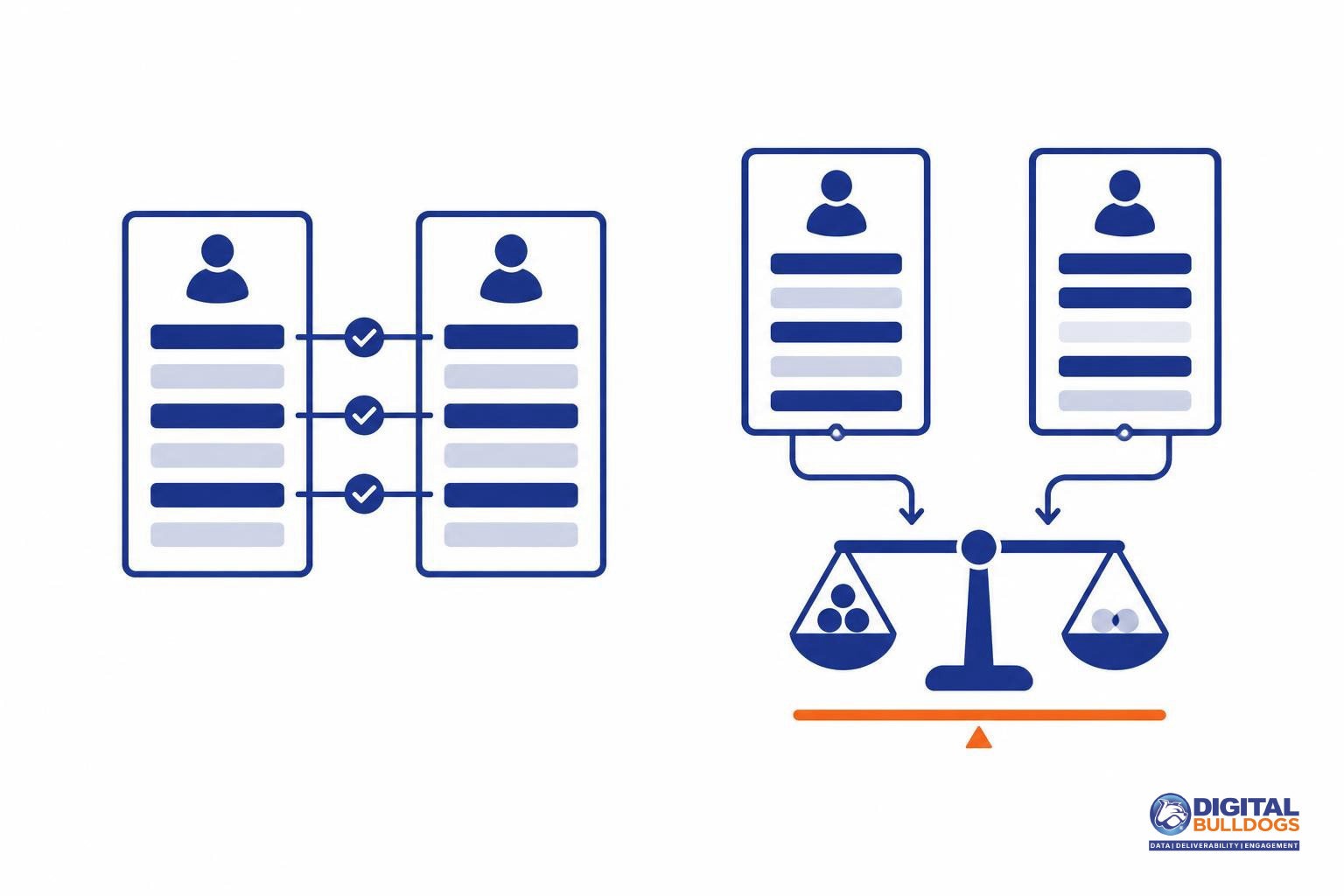
A higher append match rate is not necessarily a better result. Accepting weaker candidates can return more matches while also admitting more incorrect ones. Evaluate how many records come back alongside how many of those matches you can verify as correct.
The Office for National Statistics’ data-linkage methodology explains how matching thresholds affect false and missed matches. Two measures help distinguish coverage from correctness:
- Precision: How many accepted matches are correct?
- Recall: How many of the true matches available were found?
A vendor’s returned-record count establishes neither. Checking accepted matches can help assess precision; assessing recall also requires a reference that reveals true matches the process missed. Ask what evidence supports the vendor’s quality claims, not just how many addresses it returned.
The M3AAWG position on email appending warns that shared surnames and postal addresses can produce incorrect person-to-email correlations. It also cautions that a message being accepted does not establish delivery to the intended person. An address that accepts mail is not, by itself, proof of a correct identity match.
Keep demographic enrichment of an existing permissioned audience separate from adding an assumed email address. If your goal is to understand the audience you already have, use the demographic data append evaluation guide to evaluate that broader enrichment decision rather than treating email match volume as the measure of success.
A match does not establish permission or inbox readiness
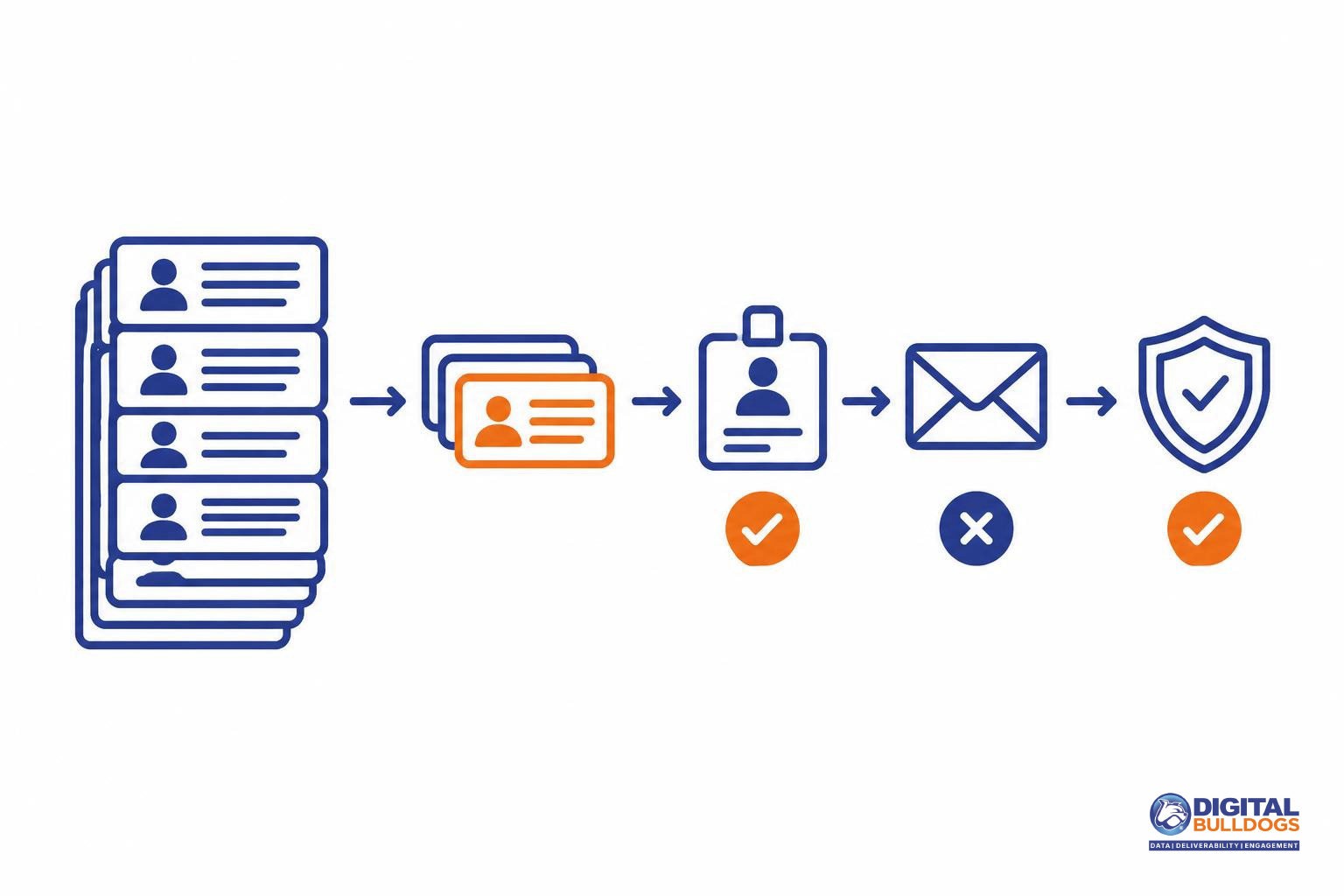
An email append match is an identity claim—not proof that you may contact that person or that your message will reach their inbox. Evaluate these separately:
- Correct identity: Does the address belong to the intended person?
- Permission to contact: What evidence supports sending marketing email to that address?
- Address status: Is the address usable, rather than invalid or inactive?
- Delivery outcome: Was the message delivered to the intended recipient, and where did it land?
Passing one check does not establish the others. M3AAWG’s position on email appending opposes nonpermission-based appending for marketing and says permission through another channel does not establish email permission. It also warns about incorrect person-to-address correlations, bounces, complaints and blocklisting. A receiving server accepting a message does not prove it reached the intended person.
That is industry guidance, not a declaration that every append violates US federal law. The CAN-SPAM requirements in the US Code address truthful transmission information, nondeceptive subject lines, opt-out mechanisms, honoring objections to further messages and required sender disclosures. A vendor’s “matched” label does not demonstrate compliance with those obligations.
Before activating appended addresses, keep suppression records intact and request evidence of email-specific permission, including how it was obtained and what the person agreed to receive. A clean-looking address or an existing postal relationship is not that evidence. Apply the same signup-source risks and consent checks you would use when reviewing any other source of contacts.
What to test on a sample before accepting a full append
Review a sample you help select before approving the full file. The goal is to check identity accuracy, document uncertainty and separate matching quality from permission and delivery readiness.
- Cover the range of your input data. Include older and newer records, complete and incomplete identifiers, and consumer or business records where relevant. Do not rely solely on a vendor-selected showcase file.
- Keep an auditable record. Retain original identifiers and request candidate status, match level, matching method, the definition of confidence, source dates and validation labels. Review identity correctness separately from mailbox-status labels: an address labeled valid does not establish that it belongs to the intended person.
- Compare against independently known records. Use reliable first-party records to examine both accepted matches and known links the vendor missed. ONS linkage methodology explains how matching thresholds affect false and missed matches. Where reliable comparison evidence is unavailable, mark the result unverified rather than treating the vendor’s output as proof.
- Apply permission and suppression checks. Check permission for the intended sender and purpose, plus applicable opt-outs and suppression records, before deciding whether to send. M3AAWG’s position on email appending warns against nonpermission-based appending and incorrect person-to-address correlations. Do not email an unpermissioned sample merely to see whether it bounces. Separately, federal commercial-email requirements address opt-outs, sender disclosures and other obligations; a match report does not establish compliance.
- Track delivery separately. For records already permissioned for the intended sender and purpose, monitor delivery outcomes separately from append accuracy. Google’s sender guidelines address authentication, complaints, recipient expectations and reputation. Keep these checks distinct in your email deliverability reporting for clients; a match report does not replace them.
Vendor questions to ask before you approve the file
Approve an append based on what the returned records can demonstrate—not just how many addresses come back. Ask the vendor to document these points before you accept the file:
- What counts as “matched”? Which records enter the calculation, which are excluded, and can you reproduce the reported rate from the returned file? Request separate counts for duplicates, unresolved records and multiple candidates.
- Who or what was matched? Is the result a person, household, company or named business contact? Ask which identifiers, matching methods and ambiguity rules support that claim. The FTC’s historical data-broker findings describe differing matching and data-quality practices—not a universal standard.
- What does each confidence label mean? Request the thresholds, independent checking and known limitations behind each label. Can uncertain matches remain unresolved? ONS linkage methodology explains why matching thresholds involve trade-offs between false and missed matches.
- Where did the address and permission evidence originate? Ask when each was refreshed and how opt-outs and suppressions survive processing. M3AAWG’s position on appending distinguishes an address association from channel-specific permission. Separately, federal commercial-email requirements include honoring opt-out requests; a match does not remove that obligation.
- Can we assess a representative sample first? Require identity findings, address-status findings and permission findings in separate fields before approving the full file. Evaluate sending readiness separately, too: Google’s sender guidelines address authentication, recipient expectations and reputation—not identity-match accuracy.
If the vendor cannot explain these distinctions, pause acceptance. More returned addresses are not automatically a better outcome.
Digital Bulldogs can help review audience-data questions alongside list hygiene and deliverability concerns. If that support would help, book a free consult.
Frequently asked questions
What is a good email append match rate?
There is no useful “good” rate without knowing what the vendor counts as a match and what identifiers you supplied. The FTC’s historical data-broker report describes differing matching and data-quality practices, not a current industry benchmark. Ask vendors to use the same input file and explain their denominator, exclusions and acceptance criteria. Compare the quality of accepted matches, not just the headline percentage.
Is email append accuracy the same as match rate?
No. Match rate describes how much of your input file received a match; accuracy concerns whether those matches identify the intended people. A returned address is not proof of a correct person-to-address connection. M3AAWG’s position on email appending specifically warns about incorrect correlations and explains that message acceptance does not establish delivery to the intended person. Ask for evidence of correctness separately from the count of returned addresses.
Does deterministic matching guarantee the right email owner?
No. Deterministic matching applies predefined agreement rules to identifiers; it does not independently verify who owns an email address. The ONS guidance on data linkage explains deterministic and probabilistic methods, identifier preparation, and false and missed matches. Ask which fields must agree and how ambiguous candidates are handled. Treat “deterministic” as a description of the matching method, not a guarantee that the returned address belongs to your customer.
Does a matched email address give us permission to send marketing?
No. Do not treat a vendor’s identity match as evidence of marketing permission. Assess your legal obligations and the recipient’s expectations separately: federal commercial-email law addresses sender information, subject lines, disclosures and opt-outs, while Google’s sender guidelines cover authentication, recipient expectations and sending practices. Neither makes a matched record proof of consent or inbox readiness. Require a documented basis for sending before adding appended addresses to campaigns.
What should we check in a vendor’s sample before accepting the full file?
Use a representative sample and request a record-level explanation of the results: identifiers used, matching method, confidence threshold, source and refresh date, duplicates, and unresolved candidates. Where you have reliable reference records, review incorrect matches as well as missed matches. Keep permission status separate from identity confidence. Agree in advance on rejection rules and whether uncertain records will be withheld; do not approve the full file solely because the sample’s match rate looks attractive.
Sources
- Data Brokers: A Call for Transparency and Accountability · Federal Trade Commission
- Developing standard tools for data linkage: February 2021 · Office for National Statistics
- M3AAWG Position on Email Appending · Messaging, Malware and Mobile Anti-Abuse Working Group
- 15 U.S.C. § 7704: Other protections for users of commercial electronic mail · Office of the Law Revision Counsel, U.S. House of Representatives
- Email sender guidelines · Google