
Lookalike Audiences From an Email List: Quality Checks
Platforms build lookalike audiences from an email list by matching customer identifiers to accounts, then using that seed to model people with similar attributes: matching finds your customers; modeling finds similar people. To judge whether the resulting audience is useful, check match quality separately from campaign performance, then test the lookalike against a prospecting control using the business outcome you care about—not just clicks.
This guide follows the seed through hashing, matching and expansion, then explains how to choose customers who reflect your goal, assess audience-size and similarity settings, and separate a successful match from a useful model. It also covers what to check about permitted use before sharing your seed, so audience quality and responsible data handling stay part of the same decision.
Start with the distinction: matching finds customers; modeling finds similar people
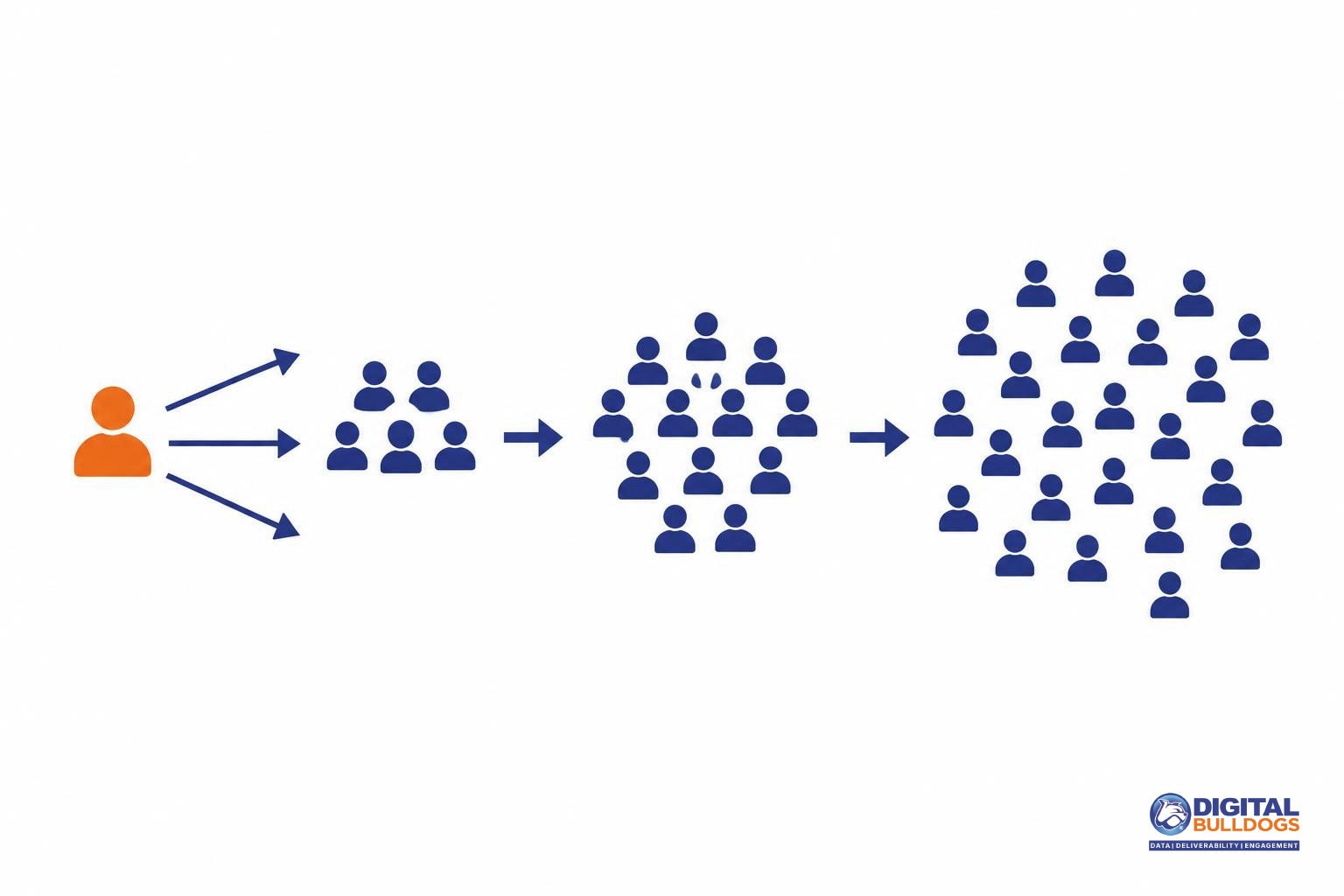
An email-list lookalike is an advertising audience modeled on a source audience—not simply the customers whose email addresses you uploaded. Matching connects supplied identifiers to platform accounts. Modeling then uses the source audience to seek other people with similar attributes.
For example, Google’s customer matching process compares normalized, hashed customer identifiers with account identifiers and adds matched accounts to Customer Match segments. That matched audience is distinct from a lookalike: TikTok describes lookalike modeling as using source-audience attributes to find similar users.
Keep three quality questions separate:
- Source quality: Does this group reflect the outcome you want? Recent buyers and engaged subscribers are seed candidates to evaluate, not automatic winners. Google recommends high-intent seed audiences, but that does not establish which customer group will perform best for your campaign.
- Matching quality: Did the supplied identifiers connect to platform accounts? An accepted upload alone does not answer that question.
- Modeled-audience quality: Does advertising to the resulting audience produce the outcome you intended? Successful matching does not establish successful prospecting.
Keep the activation channel explicit, too. Finding similar advertising users is not evidence that you have permission to email them—or that they are ready for an email campaign. Even uploading the source requires a permitted use: Google’s Customer Match policy sets requirements for first-party collection, disclosures and consent where required.
If you need help defining the seed and its intended use, Digital Bulldogs’ custom audience planning and preparation is a practical starting point.
How an email seed moves through hashing, matching and expansion
Matching asks, “Which accounts belong to these customers?” Expansion asks, “Who else resembles this audience?” They are separate steps, even when a platform presents them as a single workflow.
From Email Identifier to Matched Account
Normalize
Prepare the email identifier using the destination's formatting instructions, including trimming surrounding whitespace and converting text to lowercase.
Hash
Transform the prepared identifier into a consistent hashed representation using the supported workflow.
Match
Compare the hashed identifier with account identifiers. A successful match connects the supplied record to an account.
Google’s customer matching process normalizes identifiers, hashes eligible fields and compares the resulting identifiers with its account records. For an email-only example, normalization removes surrounding whitespace and converts text to lowercase. Hashing changes the email’s representation; matching connects that identifier to an account. Matched accounts can then become members of a Customer Match segment.
That is the foundation of building custom audiences through hashed matching. Lookalike expansion goes further: TikTok describes using attributes of the source audience to find similar people. A successful identity match does not, by itself, show that those additional people will become customers.
If a data provider handles the workflow, ask who performs each job:
- Identity matching: Which organization connects the supplied identifiers to accounts or other identifiers?
- Similarity modeling: Which platform or provider selects people beyond the source audience?
- Activation: Which organization sends the audience to the advertising destination?
Do not assume a provider follows Google’s implementation. Keep your original customer records and channel restrictions separate from the destination-specific working export. That separation helps preserve the context needed to check eligibility: Google’s Customer Match policy requires first-party collection, appropriate privacy disclosures and consent where required. Preparing an upload should not erase the restrictions attached to the underlying records.

Choose a seed that reflects the outcome you want
Choose contacts whose behavior reflects the outcome you want—not your entire database by default. Google recommends high-intent seeds, including recent converters and people who have engaged with your brand, in its current Demand Gen lookalike guidance.
As a practical starting hypothesis, compare a recent-buyer seed with a separately defined engaged-subscriber seed. Keeping them separate gives you a clearer question to test: which source audience helps you find prospects who complete your target action? When evaluating high-intent lead signals, distinguish demonstrated behavior from a broad label such as “active contact.”
Write down the rules before exporting:
- Qualifying behavior: Define engagement explicitly, such as clicks on relevant email offers or completed purchases. Keep purchase behavior distinct from subscriber engagement.
- Selection window: Record the date range used for each seed. Choose a window suited to your buying cycle rather than assuming a universal recency cutoff.
- Collection context: Document the collecting business, signup source, intended use and applicable restrictions. Reviewing signup sources and email list quality can help explain why contacts belong in different seeds.
- Identity consistency: Review duplicate records and conflicting identities so you can explain who qualifies and why.
Do not substitute appended identifiers for directly collected information without checking platform eligibility. Google’s Customer Match policy requires information collected in a first-party context and sets requirements for privacy disclosures, consent where required and approved upload methods. A usable identifier alone does not establish that a record is eligible for upload.
Balance audience size with similarity—and check what the setting actually controls
A broader lookalike can offer more reach, but the audience setting does not mean the same thing on every platform. Check whether it limits delivery or simply guides it before comparing results.
TikTok Audience Reach and Similarity Options
Narrow
Prioritizes the closest resemblance to the source audience, with relatively smaller reach.
Balanced
Sits between the narrower and broader audience options.
Broad
Increases potential reach with more moderate similarity to the source audience.
TikTok describes three options in its lookalike audience documentation: Narrow offers the closest resemblance to the source audience with smaller reach; Balanced sits between the alternatives; and Broad offers greater potential reach with more moderate similarity.
Google’s Demand Gen lookalike documentation describes a phased move to suggestion mode. Under that model, seeds and reach settings guide delivery rather than impose strict similarity boundaries. Google also says its previous creation minimum no longer applies under the updated model. Do not carry an older threshold into every campaign—or treat it as another platform’s requirement. This distinction matters when assessing why audience reach changed.
Keep these seed-size measures separate:
- Uploaded records: the customer records you submit.
- Matched accounts: accounts the platform can associate with those identifiers. Google’s customer matching process compares submitted identifiers with Google account identifiers; matched accounts enter Customer Match segments.
- Campaign eligibility: whether the resulting audience meets the requirements for the campaign and feature you are using.
A creation minimum is an eligibility rule, not evidence of the best-performing seed size. Before testing, record the seed used, the reach setting and—most importantly—whether the audience acts as a targeting constraint or a suggestion. Otherwise, similar-looking settings may produce comparisons that do not measure the same thing.
Judge match quality separately from model quality
A successful match tells you that an identifier connected to a platform account—not that the expanded audience will become customers. Google’s customer matching process compares supplied identifiers with account identifiers and adds matched accounts to Customer Match segments. Use matching feedback to investigate identifier quality and account coverage; judge the modeled audience through campaign outcomes.
When reviewing a platform report or provider proposal, ask for clear answers:
- What does “match” mean? Request the metric’s definition and denominator. Is it calculated from submitted records, unique identifiers, accepted records or another base?
- Who is being modeled? Identify the source population and any seed exclusions, including whether existing customers are excluded from the expanded audience.
- Which people were directly matched? Ask providers to distinguish matched records from people included through similarity modeling.
- What can you activate, and where? Confirm whether the deliverable is an advertising segment, a scored customer file or another permitted output. Do not assume it includes contactable email addresses.
Keep match metrics separate from campaign results in your reporting. A higher reported match rate is not, by itself, evidence of a better prospecting audience. Compare the expanded audience’s results with your prospecting control using the campaign outcome you actually want.
For proposed email activation, review collection history and channel restrictions separately, using lead identification checks before email activation. The FTC explains that hashed identifiers can remain linkable to people; hashing does not establish permission to email. A match also does not establish advertising eligibility: Google’s Customer Match policy separately requires eligible first-party collection, privacy disclosures and consent where required.
Test the lookalike against a prospecting control
Compare the lookalike with a prospecting approach that does not rely on the seed list. Retargeting answers a different question: how well you convert people who already interacted with your business, rather than how well you find new customers.
Before launch, write down what would make the lookalike useful to your business. Then build the comparison around that outcome:
- Use randomization where available. If the platform supports a randomized experiment for these approaches, use it. Keep the offer, creative, geography, conversion definition and measurement window consistent.
- Make exclusions consistent. When testing new-customer acquisition, apply the same existing-customer exclusion rules to both approaches.
- Choose the outcome first. Measure qualified leads or completed purchases, for example. Assess cost per outcome alongside downstream quality, such as whether leads meet your qualification criteria or purchases are later refunded.
- Record expansion behavior. Note the audience mode and settings used during the test. Google’s Lookalike suggestion mode can deliver beyond the selected similarity boundaries, so the comparison may evaluate a broader delivery approach—not a strictly bounded lookalike audience.
Do not call the test successful because the audience is large or matching feedback looks encouraging. Google describes Customer Match as comparing supplied identifiers with Google Account identifiers; that matching step does not establish whether modeled prospects will become valuable customers.
Judge the approaches on the business outcome you selected. If the results do not support a clear conclusion, record them as inconclusive rather than forcing a winner.
Check permitted use before sharing the seed
Before uploading an email seed, confirm who collected it, what people were told and whether the intended advertising use is permitted. Platform eligibility, federal privacy guidance and state privacy rights are separate checks.
- Platform requirements: Google’s Customer Match policy requires information collected directly from customers, appropriate disclosures about sharing with service providers, and consent where required by law or applicable policy. It also restricts sensitive-category uses. Agencies and affiliates should identify the business that collected the information directly; moving a file or adding an identifier does not, by itself, establish eligibility for another advertiser.
- Federal privacy guidance: The FTC warns that hashing does not make personal data anonymous. Hashed identifiers can remain linkable to people, so privacy statements should describe the actual handling rather than present hashing as anonymity.
- California-specific rights: For covered businesses and California consumers, the California privacy statute provides sale-or-sharing opt-out rights. Its definition of sharing includes qualifying cross-context behavioral advertising, even without payment. Applicable consumer requests must flow into the relevant audience workflow. These rules are not a nationwide consent standard.
Keep email-send suppressions distinguishable from advertising-use restrictions. Record what each restriction covers, then carry it into the relevant sending, audience-export or provider-handoff process. Do not treat permission for one use as permission for every use.
If your seed definition, provider handoff or separate email-readiness review is unclear, Digital Bulldogs can help review audience preparation and list hygiene. Book a free consultation to discuss the appropriate next steps.
Frequently asked questions
What is the difference between a custom audience and a lookalike audience?
A customer-list custom audience starts with people you already know; a lookalike audience seeks other people who resemble that source group. TikTok describes lookalike creation as modeling attributes of a source audience to find similar users. Keep the distinction clear when planning campaigns: reaching existing customers and finding new prospects are different jobs, even when both begin with the same email seed.
How large should an email seed list be for a lookalike audience?
Use the requirements for the platform and campaign type you are actually running, rather than a universal list-size target. Google’s updated Demand Gen lookalike guidance removes the previous creation minimum under its updated model; that is not a benchmark for every platform. Start with a coherent, relevant seed, check the current eligibility rules, and avoid adding unrelated contacts simply to make the upload larger.
Should I use recent buyers, email clickers or my entire list?
Choose the seed around the outcome you want. For purchase-focused prospecting, start by testing recent buyers; for an engagement goal, consider relevant email clickers. Treat your entire list as a separate test rather than the automatic default. Before uploading any group, check permitted use: Google’s Customer Match policy requires first-party collection, appropriate disclosures and consent where required. An engagement label alone does not establish permission.
Does a strong match result mean the lookalike will perform well?
No. A match result answers an identity question, not a campaign-performance question. Google explains that Customer Match compares uploaded identifiers with account identifiers and adds matched accounts to the segment. That process does not establish whether similar prospects will buy. Evaluate the lookalike separately against a prospecting control, using the same conversion goal and comparable creative, offer and measurement conditions.
Does hashing customer emails remove privacy obligations?
No. Hashing changes the representation of an email address; it does not automatically make the underlying data anonymous. The FTC explains that hashed identifiers can remain linkable to people. Treat hashing as a data-handling step, not a substitute for checking collection permissions, platform terms or applicable privacy requirements. Avoid describing an upload as anonymous simply because the email addresses were hashed.
Can a lookalike audience be used as an email sending list?
No—use it for ad targeting, not as a substitute for an email subscriber list. Audience similarity is not an email subscription, so do not treat it as permission to send. Keep permission records for your actual email contacts separate from audience-modeling decisions. Where California’s statute applies, its collection-purpose disclosures and applicable consumer-request obligations also matter when handling the customer data used for advertising.
Sources
- Use Lookalike segments to grow your audience · Google Ads Help
- About the customer matching process · Google Ads Help
- About lookalike audiences · TikTok for Business
- Customer Match policy · Google Ads Help
- No, hashing still doesn't make your data anonymous · Federal Trade Commission · 2024-07-24
- California Consumer Privacy Act of 2018 — statutory text · California Privacy Protection Agency